
Meet David
Big character. Big heart.
And a belief that your wedding should actually feel like yours.
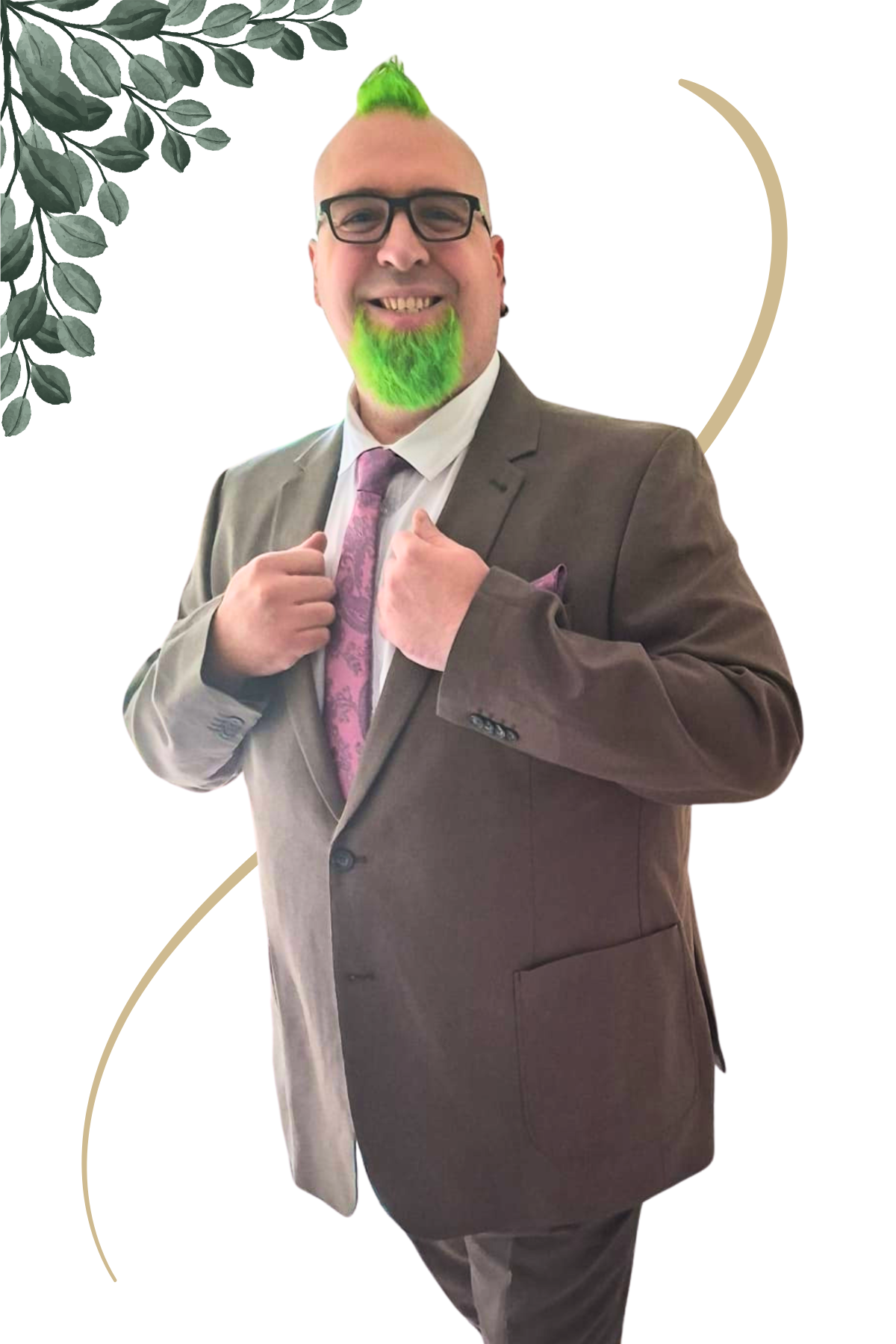
“Hi, I’m David. I’m 6'5", I have a neon-green mohawk and beard, and I’ve never been particularly good at disappearing into the background.
Fortunately, being a celebrant isn’t really a job for somebody who wants to hide behind the furniture.
But standing out is only part of who I am. What matters much more is listening — properly listening — to the people in front of me.”
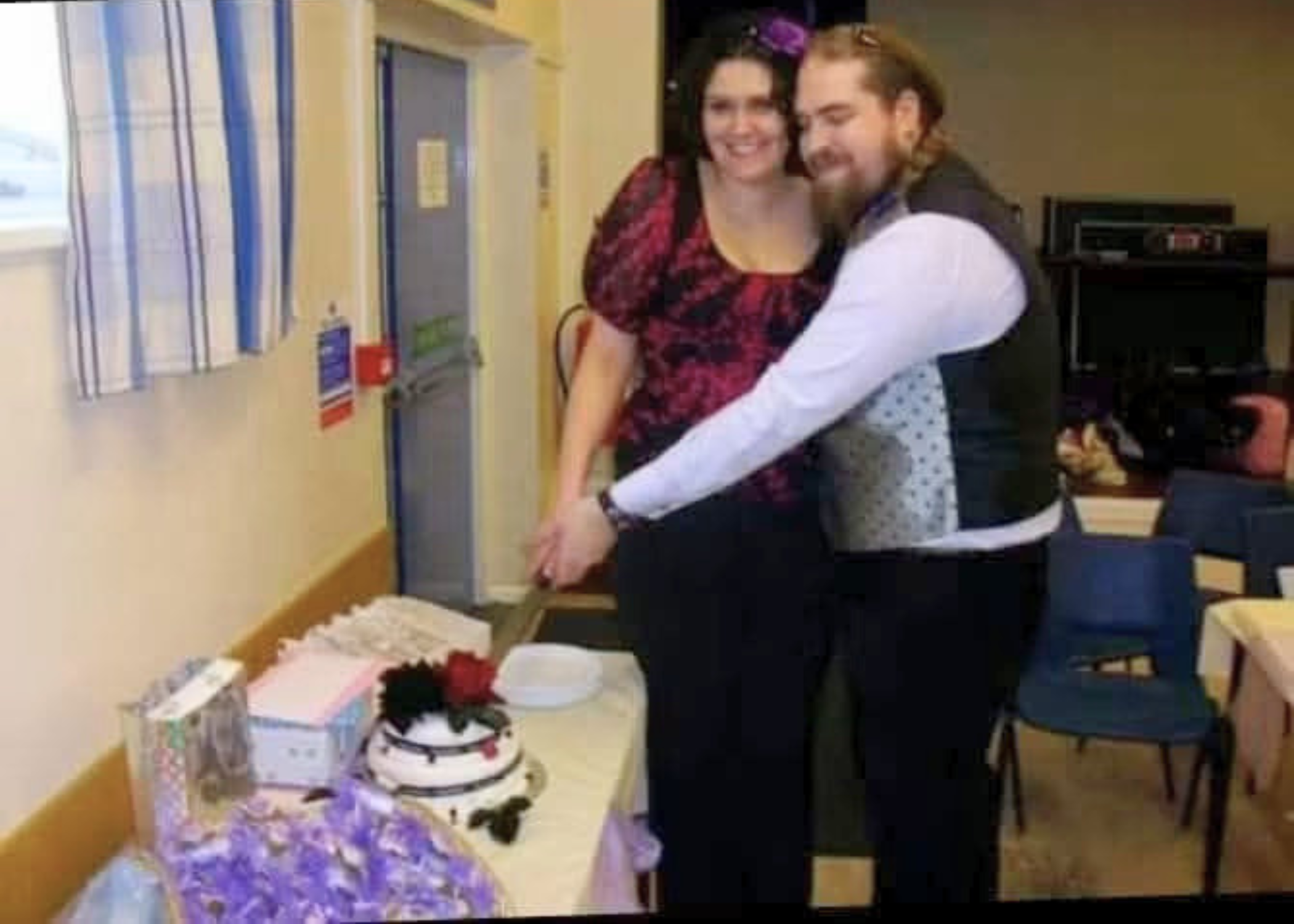
Looking back, I wish we’d known.
Gina and I married in 2010, after our first two children had already been born. We weren’t religious, so we chose a straightforward register-office wedding because, at the time, we simply didn’t know that a personalised celebrant-led ceremony was an option.
Knowing what I know now, I think we would have done things very differently.
I’m naturally the front man — happy to entertain a room, make people laugh and throw myself into the moment. Gina is much quieter and more reserved. A ceremony designed around us would have found space for both of those personalities, bringing out the best in each of us without asking either of us to become someone we’re not.
That’s one of the reasons personalised ceremonies matter so much to me now.
Your wedding shouldn’t be about squeezing yourselves into somebody else’s idea of what a ceremony is supposed to look like. It should make room for both of you — your personalities, your values, your story and the way you choose to express yourselves.
The ceremony should fit the people — not the people fit the ceremony.
Sometimes you just have to do the thing.
In early 2026, a friend and martial arts student of mine died at the age of 70.
As I learned more about the way he had lived, something really stayed with me.
At 55, he decided to get his HGV licence. While he was doing that, he thought he might as well get his PCV bus licence too — and then spent the next 15 years loving driving buses around town.
At 66, he took up martial arts.
He went paragliding.
When something interested him, he tried it.
He seemed completely unapologetic about being himself and making the most of the life in front of him.
That inspired me.
I had already discovered celebrancy. I already knew it excited me. I had just been very good at talking myself out of taking the leap.
So I stopped putting it off.
I stopped talking myself out of celebrancy.
And I decided to do the thing.
Different careers. The same thread.
My route into celebrancy has been anything but conventional, but when I look back, there is one thing that connects everything I’ve done:
Hospitality
I originally trained in hospitality and catering and worked towards hotel management.
That taught me the value of service — listening properly, understanding what people need and making sure they feel looked after.
Policing
I then spent nearly two decades as a frontline police officer with West Midlands Police.
That taught me to listen to people as individuals, to work with people from every walk of life and identity, and to stay calm and clear even when situations were difficult or emotional.
It also taught me how to write clearly and professionally while still reflecting the person behind the information, and how to stand in front of a room and communicate with confidence.
Teaching
After leaving policing, I moved into teaching martial arts for self-defence, health and wellbeing.
Teaching sharpened my ability to adapt — to recognise that different people communicate, learn and express themselves in different ways.
It also gave me years of experience presenting, performing and engaging groups of people.
All of those skills now come together in celebrancy.
I can listen to your story. I can write it. And when the day comes, I can stand in front of everyone you love and tell it.
Why humanist ceremonies?
For me, humanism is about recognising the humanity we all share, regardless of religion, identity, background or belief.
It doesn’t rely on divine intervention or religious doctrine to give life meaning. Instead, it places value on the one life we know for certain we have — living it fully, treating other people with compassion and respect, caring about the world around us, and celebrating the people we love.
That is why humanist celebrancy felt like such a natural fit for me.
I believe people without religion deserve ceremonies every bit as meaningful, emotional and significant as those with religious beliefs.
You don’t have to call yourself a humanist to work with me.
What matters is that you’re looking for a non-religious ceremony that puts the two of you at the centre.
I won’t conduct prayers, read religious scripture or invoke religious belief as part of my role as a humanist celebrant. But families are complicated, cultures overlap, and the people we love don’t always share the same beliefs.
If there is something important to you or your family, talk to me.
Within the boundaries of a humanist ceremony, we can explore what works.
Meaning doesn’t have to come from religion. It can come from love, memory, connection and the life you choose to build together.
No cookie-cutter weddings.
Change the names and, far too often, you could be at almost anybody’s wedding.
That isn’t what I want to create. I want to find the details that make the two of you unmistakably you.
What have you been through together?
The adventures, challenges, changes and completely ordinary days that turned two people into a partnership.
And what absolutely must NOT happen?
No unwanted traditions. No awkward wording. No pretending to be people you’re not.
If something feels wrong for you, we don’t include it simply because “that’s what weddings do”.
Humour, emotion, readings, music, rituals, stories, surprises, unusual ideas — we find the balance that belongs to the two of you.
How did you meet?
The real version. Not necessarily the polished one you tell your grandparents.
What makes you laugh?
Because a ceremony can be meaningful without being solemn from beginning to end.
What drives each other mad?
Sometimes the little quirks say just as much about a relationship as the grand romantic moments.
Who matters to you?
Family, friends, children, people you want involved — and people you want remembered.
What does marriage mean to you?
Not what tradition says it should mean. What are the promises you are actually making to each other?
The goal isn’t to make your wedding unconventional.
It’s to make it authentic.
So what happens when we meet?
You get me.
A big guy with a big personality and an even bigger heart.
There’s no hard sell and no expectation that you have everything figured out before we sit down.
We’ll meet somewhere you feel comfortable — I usually suggest a coffee shop, and the drink is on me — and we’ll talk about you, your plans, your hopes and the kind of ceremony you’d create if nobody was standing over your shoulder telling you what a wedding is supposed to look like.
Think of it as a vibe check.
You’re deciding whether I’m someone you trust to stand beside you on one of the biggest days of your life.
And I’m making sure I understand what you’re asking for and that I genuinely believe I can deliver it.
If you’ve got an unusual idea, pitch it.
Provided it’s legal, safe and compatible with the humanist ceremony I’ve agreed to provide, my first question is much more likely to be:
“How could we make that work?”
than:
“That’s not how weddings are done.”
He listened to us.
He gets us.
We can trust him with our story.
That’s what I hope you’re thinking by the time we’ve had our first coffee.
Because choosing a celebrant isn’t just about finding someone who can stand at the front and speak clearly.
It’s about finding someone who will listen properly, respect who you are, understand what matters to you, and turn that into something meaningful.
Someone who can bring warmth, humour, creativity and confidence to the room without making the ceremony about themselves.
Someone who can tell your story in a way that feels accurate, personal and unmistakably yours.
If that sounds like what you’re looking for, I’d love to hear about the two of you.